Specific learning disability (SLD) is the most commonly identified eligibility category in special education, and in Texas it is also one of the most documentation-intensive. The criteria are grounded in federal law but administered through state regulation, interpreted through multiple established frameworks, and applied to students whose profiles are rarely clean or simple. For a diagnostician building an evaluation, the question is rarely just "does this student qualify?" — it is "which framework best fits this student's data, and can I defend that decision in an ARD?"
This walkthrough covers the full SLD determination process as it applies in Texas: the federal and state legal basis, the three identification approaches, all seven SLD domains, exclusionary factors, and what data convergence actually looks like in practice. The legal framework, however, is grounded in decades of reading science — so that's where we'll begin.
Why the Reading Rope Matters Here
Before the law, there is the research. Hollis Scarborough's Reading Rope (2001) is the most useful single framework for understanding why specific learning disabilities exist and why the SLD eligibility domains are organized the way they are. It describes skilled reading as two distinct strands that become increasingly integrated over time.
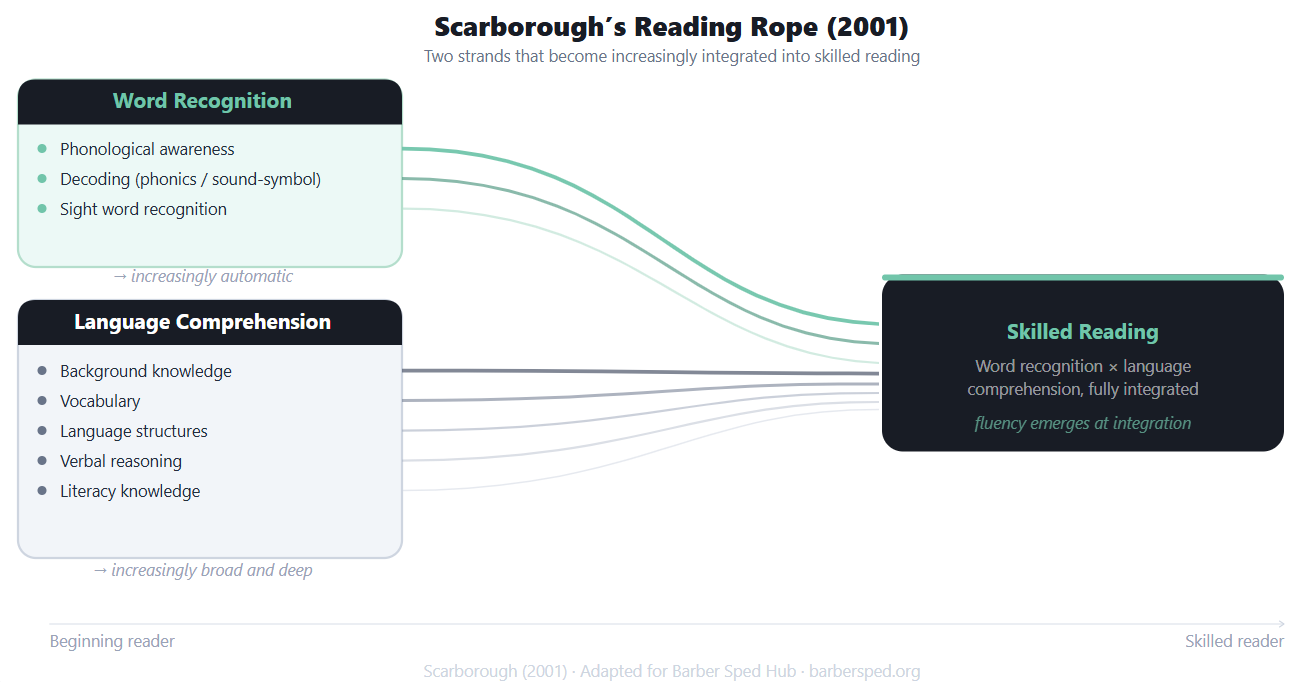
The word recognition strand is where most SLD-Reading profiles break down. Within CHC theory, the cognitive abilities most implicated are Phonological Processing (Ga) — particularly phonological awareness and phonological memory — and Processing Speed (Gs) through rapid automatized naming. A student with dyslexia typically has a discrete weakness in one or more of these narrow abilities while language comprehension remains relatively intact. This is precisely why the dyslexia profile is called "unexpected": the student has the cognitive and language foundations to comprehend text, but cannot access that comprehension efficiently because decoding is labored or inaccurate.
The Language Comprehension strand is where oral language lives — vocabulary depth, listening comprehension, background knowledge, and the ability to process connected discourse. Students with strong oral language but weak word recognition often appear capable in conversation and discussion, then struggle significantly the moment print is involved. The reverse pattern — strong decoding, weak oral language — tends to produce students who read words accurately but comprehend little of what they read. Both patterns are educationally significant, and both are visible in the Rope model when you know where to look.
The rope model also makes clear why reading fluency is its own eligibility domain. Fluency is the integration point — the place where the two strands weave together into automaticity. In CHC terms, this is where Reading and Writing (Grw) narrow abilities like reading speed and reading fluency emerge from the interaction of phonological processing and oral language ability. A student can decode accurately but slowly, and that slow, effortful decoding creates a bottleneck that impairs comprehension even when language comprehension skills are strong. That bottleneck is a legitimate educational disability in its own right, and Texas law recognizes it as such.
Understanding the rope — and where a student's profile breaks — is the conceptual foundation that makes SLD determination coherent rather than a checklist exercise.
The Legal Framework: What Texas Actually Requires
The federal definition of SLD in IDEA 2004 describes it as a disorder in one or more basic psychological processes involved in understanding or using language (spoken or written) that manifests as an imperfect ability to listen, think, speak, read, write, spell, or do mathematical calculations. Critically, IDEA moved away from the traditional IQ-achievement discrepancy model and opened the door to alternative approaches — including response to intervention and pattern-based analyses.
Texas recognizes three approved identification approaches, each requiring its own documentation framework.
Three Identification Approaches
In practice, the approaches are not mutually exclusive. C-SEP is itself a bridge between pattern-based analysis and performance data, and many evaluations draw on elements of more than one framework. The key requirement regardless of approach is that all data converge on the same conclusion.
The Seven SLD Domains
Texas recognizes eight SLD eligibility areas under TAC §89.1040, mapped to seven academic skill areas (oral expression and listening comprehension count as two separate areas within domain 7). Each domain must be evaluated with technically adequate measures, and eligibility in any one domain requires the full data pattern — not just a low score.
Exclusionary Factors: What You Must Rule Out
IDEA and Texas law require that a learning disability not be primarily the result of any of the following:
- Visual, hearing, or motor disability
- Intellectual disability
- Emotional disability
- Cultural or environmental factors
- Limited English proficiency
- Lack of appropriate instruction in reading or math
For students who have not had adequate access to instruction, the data should reflect this directly. If tier 2 and tier 3 interventions have been in place and the student has still not responded, the "lack of instruction" exclusionary is effectively addressed. If MTSS documentation is thin, this becomes a significant documentation vulnerability.
What Data Convergence Actually Looks Like
The requirement for convergent evidence is one of the most important — and most misunderstood — pieces of SLD determination. A single low score is not a learning disability. Convergent data means that the same pattern shows up across multiple independent sources, and each source tells a consistent story.
In a well-documented SLD evaluation, the pattern holds across every source: formal scores, cognitive processing data, CBM performance, teacher observations, and parent developmental history all point to the same conclusion. No single source proves eligibility. Together, they make the case compelling and defensible.
Common Documentation Pitfalls
Single-source eligibility. If the entire SLD case rests on one achievement composite, the evaluation is incomplete. The requirement for convergence exists precisely because tests have measurement error, and no single measure is the final word on a student's abilities.
Scores without interpretation. A score table without narrative interpretation is not a FIE — it is a score summary. The evaluation report must explain what the scores mean, how they relate to each other, and what the pattern implies for educational performance. The diagnostician's interpretation is the product, not the scores themselves.
Exclusionary factors treated as formalities. "Cultural and linguistic factors were considered and ruled out" is not documentation. For English learner students especially, this section needs to show actual data — what language was the student assessed in, what were the comparative results, and what does language dominance data indicate?
Missing the adverse effect connection. In Texas, eligibility also requires that the disability adversely affects educational performance such that special education services are needed. A student whose low scores have not translated into academic difficulties in the general education setting may not meet the full eligibility threshold even if processing weaknesses are present. Impact documentation is not a formality — it is a required piece of the eligibility determination.
Reports that inform rather than communicate. A FIE that reads as a list of deficits without context is not serving the student, the family, or the ARD committee. Scores need to be translated into what they mean in the classroom — which tasks break down, under what conditions, and why. Task demand analysis asks what a given academic task actually requires cognitively, and where in that chain the student's profile creates friction. A parent should be able to read the report and understand what their child's experience is — not just what is wrong with them.
Putting It Together
SLD eligibility in Texas is a convergence argument. You are not looking for a single disqualifying score or a single confirming score — you are building a case from multiple angles that all point to the same conclusion. The Reading Rope gives you the theoretical framework to understand why certain cognitive deficits produce certain academic outcomes. Texas law gives you the procedural structure for documenting what you found. Your professional judgment holds both together.
Eligibility is not the finish line. It is the point at which a clearly documented pattern of difficulty becomes the foundation for specially designed instruction. Everything in the evaluation — every score, every observation, every piece of convergent data — exists to get a student to that foundation as accurately as possible.
References
- Individuals with Disabilities Education Improvement Act of 2004, Pub. L. No. 108-446, 118 Stat. 2647 (2004). https://www.govinfo.gov/content/pkg/PLAW-108publ446/pdf/PLAW-108publ446.pdf
- Scarborough, H. S. (2001). Connecting early language and literacy to later reading (dis)abilities: Evidence, theory, and practice. In S. B. Neuman & D. K. Dickinson (Eds.), Handbook of early literacy research (Vol. 1, pp. 97–110). Guilford Press.
- Schultz, E. K., & Stephens, T. L. (2015). Core-selective evaluation process: An efficient & comprehensive approach to identify students with SLD using the WJ IV. The DiaLog, 44(2), 5–12.
- Tex. Admin. Code tit. 19, § 89.1040 (2026).
- Tex. H.B. 3928, 86th Leg., R.S. (2019) (codified in relevant part at Tex. Educ. Code § 38.003).
- 34 C.F.R. §§ 300.307–300.311 (2024).