MTSS (Multi-Tiered System of Supports) is not a program that appeared fully formed. It’s a convergence — the moment education recognized that two frameworks that seemed to solve separate problems were actually solving the same problem. One framework grew partly out of concerns about who gets labeled. The other grew partly out of concerns about who gets pushed out. This is their story — and it is also the story of what happens to a child struggling in a classroom today, before anyone has written the word evaluation. That child is where all of this history is headed.
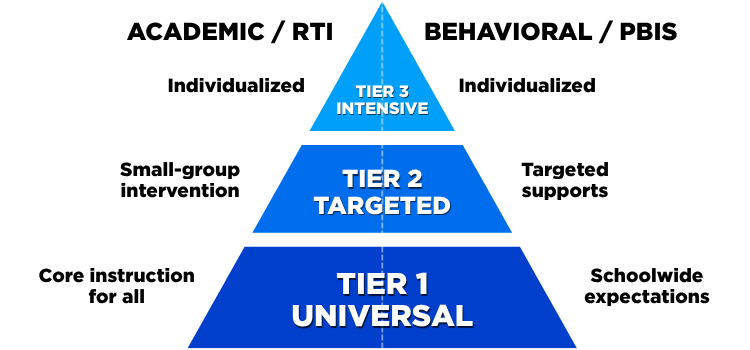
Where the Triangle Came From: Public Health’s Prevention Model
Before MTSS, before RTI (Response to Intervention), before PBIS (Positive Behavioral Interventions and Supports), before any of the acronyms, there was a public health psychiatrist named Gerald Caplan who in 1964 brought a deceptively simple idea into mental health: that interventions could be organized by when they occur relative to a problem.
Caplan did not invent the three-level structure. Public health had already sorted prevention into primary, secondary, and tertiary levels, a classification associated with Leavell and Clark (1965) and applied to infectious disease, obstetrics, and cardiovascular health. Caplan carried that structure into mental health (Caplan, 1964): primary (stopping the problem before it starts), secondary (early detection and response), and tertiary (reducing the impact of an established condition). These were not school concepts. They were medical concepts. But the logic was clean enough to travel.
Two decades later, Robert Gordon (1983) offered a complementary framework that reframed the same question in terms of audience rather than timing: universal supports (for everyone), selective supports (for those at elevated risk), and indicated supports (for those already showing signs of difficulty). Together, Caplan and Gordon gave education a conceptual skeleton that researchers would spend the next 40 years filling in.
The translation to schools was not automatic. School-specific language (universal instruction, targeted or strategic intervention, intensive intervention) had to be developed deliberately, because “primary,” “secondary,” and “tertiary” did not map cleanly onto teaching and learning. However, the triangle’s architecture (the familiar three-level pyramid, a wide base of universal supports for all students narrowing to intensive supports for the few at the top) was already there, borrowed from public health, waiting for education to claim it.
The Behavior Strand: How PBIS Was Born
The Problem It Was Solving
By the 1980s, school discipline was largely reactive. Schools removed students who exhibited problem behaviors: suspending them, sending them to alternative placements, or excluding them from the general education setting. No systematic framework existed to prevent problem behavior school-wide, and the interventions that did exist were often disconnected, inconsistently applied, and not evidence-based (Sugai & Horner, 2002).
The overrepresentation problem was also becoming impossible to ignore. Students of color and students from low-income households were being disciplined at disproportionate rates — not necessarily because their behavior was more severe, but because the systems schools were using did not have the infrastructure to respond proactively or equitably (Skiba et al., 2002). Later national data showed the same pattern for students with disabilities, who were suspended at about twice the rate of their peers (Losen & Gillespie, 2012).
The University of Oregon and the Birth of a Framework
During the 1980s, researchers at the University of Oregon (Hill Walker, Robert Horner, George Sugai, and colleagues) began systematically studying the effectiveness of discipline strategies for students with behavioral disabilities. Their 1996 paper in the Journal of Emotional and Behavioral Disorders, “Integrated Approaches to Preventing Antisocial Behavior Patterns among School-Age Children and Youth,” is a landmark: it explicitly applied the U.S. Public Health Service’s conceptual model of primary, secondary, and tertiary prevention to school behavior systems (Walker et al., 1996). This is arguably when the public health triangle was formally planted in the soil of K–12 education (Integrated Multi-Tiered Systems of Support Research Network, 2023).
The 1997 reauthorization of the Individuals with Disabilities Education Act (IDEA) wrote positive behavioral interventions and supports into federal special education law — though its component practices and principles, particularly those drawn from applied behavior analysis, had been studied since the 1960s and 1970s. PBIS is best understood as a marriage of behavioral theory, applied behavior analysis, and prevention science (Sugai & Horner, 2002).
The Legislative Catalyst: IDEA 1997
The 1997 IDEA reauthorization did two things that mattered enormously for PBIS (Individuals with Disabilities Education Act Amendments, 1997):
- It mandated that schools implement positive behavioral interventions and supports and conduct functional behavior assessments for students with disabilities whose behavior obstructs their own learning or the learning of others. PBIS became the behavioral framework specifically named in federal special education law.
- It funded the establishment of a national Center on Positive Behavioral Interventions and Supports, which was awarded to researchers at the University of Oregon (Sugai & Horner, 2020). This center created the institutional infrastructure (training, technical assistance, dissemination) that allowed PBIS to scale.
By the time IDEA was reauthorized again in 2004, PBIS had an established national footprint and a growing evidence base (Sugai & Horner, 2020).
The Academic Strand: How RTI Was Born
The Problem It Was Solving
For decades, the dominant method for identifying students with specific learning disabilities (SLD) was the IQ-achievement discrepancy model: compare a student’s expected achievement (estimated from IQ) to their actual achievement, and if the gap is large enough, they qualify. This model had layered, serious problems (Fletcher et al., 2019; Stuebing et al., 2002).
First, critics raised concerns about the cultural and linguistic limitations of standardized cognitive measures and about the model’s contribution to inequitable identification patterns. Second, because discrepancies often do not emerge until late second, third, or even fourth grade, students had to fail significantly before they could receive services. Educators and parents watched students struggle while being told to wait. Third, by the time eligibility was established, secondary consequences of school failure (poor self-concept, compromised motivation, widening vocabulary gaps) had already begun to accumulate. Critics came to describe the resulting dynamic as “wait to fail” — the phrase that Lyon et al. (2001) fixed in the field’s vocabulary.
Early forms of what would become RTI began with teachers and counselors working together to identify underachieving students and implement interventions before formally identifying a disability. These collaborative problem-solving teams — teacher assistance teams and prereferral intervention teams in the literature of the time (Chalfant et al., 1979; Graden et al., 1985), later Student Support Teams (SSTs) in many districts — preceded what RTI would systematize.
The Legislative Catalyst: IDEA 2004
IDEA 2004 was the turning point (Individuals with Disabilities Education Improvement Act, 2004). The reauthorized law:
- Allowed school districts to use a student’s response to scientific, research-based intervention as part of an SLD evaluation (20 U.S.C. § 1414(b)(6)(B))
- No longer required consideration of an IQ-achievement discrepancy (§ 1414(b)(6)(A))
- Permitted districts to use up to 15% of their special education funds for early intervention activities (§ 1413(f))
Notably, the term “Response to Intervention” does not appear in the text of IDEA 2004 — it became shorthand in the field for the process of early identification and escalating support. Doug Fuchs and Lynn Fuchs at Vanderbilt University, two of the foremost RTI researchers, described its dual purpose: to provide early support to students having academic difficulties and to offer an alternative to the discrepancy model. As Fuchs and Fuchs (2006) framed it, RTI encouraged educators to teach a struggling child more intensively, monitor their response, and use that data as evidence — allowing students who respond well to avoid special education identification and flagging those who do not for more comprehensive evaluation.
RTI was closely aligned with the No Child Left Behind Act of 2001 (signed in January 2002; No Child Left Behind Act, 2002) and its emphasis on scientifically based instruction and universal screening. This connection gave RTI its general-education grounding and made it distinct from a special-education identification procedure alone (Fuchs et al., 2003).
The Convergence: Why Two Frameworks Became One
By the mid-2000s, districts implementing both RTI and PBIS began noticing something: they were essentially doing the same work twice. Both used tiered structures. Both relied on universal screening and progress monitoring. Both involved team-based problem solving. Both were grounded in data. The frameworks looked different on paper but operated on the same logic (McIntosh & Goodman, 2016; Sugai & Horner, 2009).
And underneath the shared logic was a shared purpose: RTI had grown from a worry about who gets labeled, PBIS from a worry about who gets pushed out, and both were, at bottom, answers to the same question — how a school keeps a struggling child from being sorted out of it. Merging the mechanics only made explicit what the mission already made clear.
The practical overlap accelerated the conceptual merger. Florida was among the first states to formally build a state-level tiered framework, publishing an RtI implementation plan in 2008 and integrating academic and behavioral supports into MTSS in the years that followed (Florida’s Problem-Solving/Response to Intervention Project, n.d.) — recognizing that to achieve academic success, a student must also have behavioral supports, and vice versa. The frameworks formally united later. The term “MTSS” increasingly came to describe districts’ efforts to integrate the two systems (McIntosh & Goodman, 2016), and it entered the federal policy vocabulary with the Every Student Succeeds Act (ESSA) in 2015.
The ESSA Moment: 2015
The Every Student Succeeds Act, signed into law on December 10, 2015, included specific language on integrated supports, PBIS, and MTSS, and it was the first federal education statute to define the term: at § 8101(33), a comprehensive continuum of evidence-based practices, with regular observation to support data-based instructional decisions (Every Student Succeeds Act, 2015). ESSA wrote MTSS into its definition of professional development, the term that governs its teacher-effectiveness funding.
MTSS is not mentioned in IDEA itself; PBIS appears there only as something IEP teams must consider, not as a prerequisite to evaluation. Both live mainly in advisory statements and in ESSA. Advisory statements are also the least durable part of the record: the Department’s own 2017 explainer on the origins of MTSS, which I cited in an earlier draft of this piece, no longer exists at any federal address, and this history now survives mainly in the research network’s own brief. However, the federal requirement that states permit a process to determine whether a child responds to scientific, research-based intervention (34 C.F.R. § 300.307) remains the legal foundation of RTI as a method for identifying specific learning disabilities — the academic evaluation pathway at the system’s core.
Where MTSS Stands Now
As of the mid-2020s, MTSS is used in some form in virtually every U.S. state and territory, and thousands of districts have adopted it — though no representative national dataset tracks precise implementation, and the survey figures that circulate come from self-selected samples rather than a census (Prothero, 2023). The framework has continued to evolve: many states and districts now implement what researchers call an Integrated MTSS (I-MTSS), which explicitly unifies academic, behavioral, and social-emotional supports within a single system infrastructure.
The Integrated MTSS (I-MTSS) Research Network, funded by the Institute of Education Sciences beginning in 2019, represents the current generation of research investment in making MTSS evidence-based and systematically implementable (Integrated Multi-Tiered Systems of Support Research Network, 2023).
Why This History Matters for Texas Diagnosticians
For a Texas diagnostician, this history is not background. It describes the pipeline that ends at your door.
Under Texas rule, a referral for an initial full individual evaluation (FIE) must be part of the school district’s “multi-tiered system of academic and behavioral supports” (19 TAC § 89.1011(a)). The framework is now in the rule by name. That wording dates only to July 2024; before then, the rule placed referral within the district’s “overall, general education referral or screening system.” A student who is not making progress in the general education classroom should be considered for the interventions and supports the campus offers every student, including tutoring and evidence-based intervention.
In other words, the tiered structure this post has traced — Caplan’s prevention levels, RTI’s academic escalation, PBIS’s behavioral one, converged into MTSS — is not an abstraction that lives in the research literature. In Texas, it is the front porch of special education. It is the porch, though, not the door. It is the thing a struggling student goes through before anyone writes the word “evaluation.”
That placement carries a documented risk, and the state has drawn a hard line around it. MTSS is where evidence accumulates; it is not a gate a child must clear. Texas is explicit on this point: an LEA (local educational agency) may not deny a referral or delay an initial evaluation because MTSS or other interventions have not been implemented. If there is reason to suspect a disability and a need for special education, the student must be referred regardless of whether they have participated in an intervention program (Texas Education Agency [TEA], 2025). The rule now says so directly: a district cannot require a student to spend any set length of time in interventions before a referral is made or an evaluation is conducted (19 TAC § 89.1011(a)). The federal position is the same: OSEP has said an LEA may not use MTSS to delay or deny an evaluation, and that IDEA does not require MTSS before a referral (U.S. Department of Education, Office of Special Education and Rehabilitative Services, 2021). The distinction matters because the same “wait to fail” dynamic that RTI was built to end can quietly reassemble itself if tiers become a waiting room. The diagnostician sits at exactly the point where that line is held or lost.
Held correctly, though, the tiered system does something valuable for the evaluation that follows it. Look at what MTSS actually produces. In a Texas MTSS framework, screening is administered in the universal tier, progress monitoring runs across all tiers, and diagnostic assessment intensifies in the upper tiers — all of which a problem-solving or student support team collects and analyzes to make data-based decisions (TEA, n.d.). That is not merely a set of interventions. It is a body of evidence: universal screening data, documented instructional response, progress-monitoring slopes, and team observation, assembled over time and across settings. When a referral is made, that evidence does not disappear. It becomes the first strand of the convergent-evidence framework the FIE is built on — the principle that no single measure decides anything, and that a defensible conclusion emerges only where multiple independent sources of data point the same direction.
From the diagnostician’s chair, the history of MTSS is the history of where an evaluation’s earliest evidence comes from. The screening that flagged the student, the interventions that were tried, the way the student did or did not respond — those are not preliminaries to the FIE. They are its opening data.
And the FIE takes that opening data and uses it more systematically, gathering convergent evidence domain by domain: how the student reasons, remembers, and attends; what the student can and cannot yet do against grade-level expectations; the classroom, the instruction, and the environment in which the student is asked to learn; and what the student’s behavior accomplishes and what keeps it in place. It closes with what the findings require.
That sequence — cognitive, academic and functional, ecological, behavioral, conclusions and recommendations — is the architecture of an evaluation. It is also the map of what comes next in this series.
Everything above points the evaluation where it is normally pointed: at the child. But an evaluation framework is a tool, and you can turn a tool on its head. The next arc of The Policy Landscape — the Diagnostic Series — takes the FIE’s own method and aims it at the special education system itself. It asks the questions a diagnostician asks about a struggling student, and asks them about the structure that evaluates students: What can it actually do, measured against its own stated goals? Where is it really, as opposed to where it says it is? What would an honest plan to fix it require? Same domains, same evidence standard — a different subject.
The referral is the threshold. On one side, a student moves through tiers of support. On the other, an evaluation begins. This post has walked you to that threshold. Beginning with the next installment — The Referral — the Diagnostic Series steps across it.
Key Takeaways
- The three-tier model did not originate in education — it came from public health’s prevention framework (Caplan, 1964; Leavell & Clark, 1965) and Gordon’s (1983) universal/selective/indicated classification.
- PBIS emerged from the University of Oregon in the 1980s to address behavioral exclusion and discipline inequity; IDEA 1997 gave it federal legitimacy and national infrastructure.
- RTI emerged as a direct challenge to the IQ-achievement discrepancy model’s “wait to fail” dynamic; IDEA 2004 gave it legal standing.
- The two frameworks converged into MTSS because practitioners noticed they were doing the same work with different labels — and because the problems they were solving (who gets labeled, who gets pushed out) were ultimately connected to the same underlying concern: how a school responds when a student struggles.
- ESSA 2015 gave MTSS its federal name. But the triangle has roots that go back more than 60 years.
Related Hub Tools

References
- Caplan, G. (1964). Principles of preventive psychiatry. Basic Books.
- Chalfant, J. C., Pysh, M. V., & Moultrie, R. (1979). Teacher assistance teams: A model for within-building problem solving. Learning Disability Quarterly, 2(3), 85–96. https://doi.org/10.2307/1511031
- Every Student Succeeds Act of 2015, Pub. L. No. 114-95, 129 Stat. 1802 (2015) (definition of multi-tier system of supports codified at 20 U.S.C. § 7801(33)).
- Fletcher, J. M., Lyon, G. R., Fuchs, L. S., & Barnes, M. A. (2019). Learning disabilities: From identification to intervention (2nd ed.). Guilford Press.
- Florida’s Problem-Solving/Response to Intervention Project. (n.d.). History and future of MTSS in Florida. https://florida-rti.org/floridaMTSS/history.htm
- Fuchs, D., & Fuchs, L. S. (2006). Introduction to response to intervention: What, why, and how valid is it? Reading Research Quarterly, 41(1), 93–99. https://doi.org/10.1598/RRQ.41.1.4
- Fuchs, D., Mock, D., Morgan, P. L., & Young, C. L. (2003). Responsiveness-to-intervention: Definitions, evidence, and implications for the learning disabilities construct. Learning Disabilities Research & Practice, 18(3), 157–171. https://doi.org/10.1111/1540-5826.00072
- Gordon, R. S. (1983). An operational classification of disease prevention. Public Health Reports, 98(2), 107–109.
- Graden, J. L., Casey, A., & Christenson, S. L. (1985). Implementing a prereferral intervention system: Part I. The model. Exceptional Children, 51(5), 377–384. https://doi.org/10.1177/001440298505100502
- Individuals with Disabilities Education Act Amendments of 1997, Pub. L. No. 105-17, 111 Stat. 37 (1997).
- Individuals with Disabilities Education Improvement Act of 2004, Pub. L. No. 108-446, 118 Stat. 2647 (2004).
- Integrated Multi-Tiered Systems of Support Research Network. (2023). Brief history of I-MTSS: Summary of major milestones toward an I-MTSS framework. University of Connecticut. https://mtss.org/wp-content/uploads/2023/03/Major-Milestones-toward-I-MTSS-3.13.23.pdf
- Leavell, H. R., & Clark, E. G. (1965). Preventive medicine for the doctor in his community (3rd ed.). McGraw-Hill.
- Losen, D. J., & Gillespie, J. (2012). Opportunities suspended: The disparate impact of disciplinary exclusion from school. The Center for Civil Rights Remedies at The Civil Rights Project, University of California, Los Angeles. https://civilrightsproject.ucla.edu/resources/projects/center-for-civil-rights-remedies/school-to-prison-folder/federal-reports/upcoming-ccrr-research/losen-gillespie-opportunity-suspended-2012.pdf
- Lyon, G. R., Fletcher, J. M., Shaywitz, S. E., Shaywitz, B. A., Torgesen, J. K., Wood, F. B., Schulte, A., & Olson, R. (2001). Rethinking learning disabilities. In C. E. Finn Jr., A. J. Rotherham, & C. R. Hokanson Jr. (Eds.), Rethinking special education for a new century (pp. 259–287). Thomas B. Fordham Foundation & Progressive Policy Institute.
- McIntosh, K., & Goodman, S. (2016). Integrated multi-tiered systems of support: Blending RTI and PBIS. Guilford Press.
- 19 Tex. Admin. Code § 89.1011 (2026) (full individual and initial evaluation).
- No Child Left Behind Act of 2001, Pub. L. No. 107-110, 115 Stat. 1425 (2002).
- Prothero, A. (2023, November 8). What we know about multi-tiered systems of supports (MTSS), in charts. Education Week. https://www.edweek.org/teaching-learning/what-we-know-about-multi-tiered-system-of-supports-mtss-in-charts/2023/11
- Skiba, R. J., Michael, R. S., Nardo, A. C., & Peterson, R. L. (2002). The color of discipline: Sources of racial and gender disproportionality in school punishment. The Urban Review, 34(4), 317–342. https://doi.org/10.1023/A:1021320817372
- Stuebing, K. K., Fletcher, J. M., LeDoux, J. M., Lyon, G. R., Shaywitz, S. E., & Shaywitz, B. A. (2002). Validity of IQ-discrepancy classifications of reading disabilities: A meta-analysis. American Educational Research Journal, 39(2), 469–518. https://doi.org/10.3102/00028312039002469
- Sugai, G., & Horner, R. H. (2002). The evolution of discipline practices: School-wide positive behavior supports. Child & Family Behavior Therapy, 24(1–2), 23–50. https://doi.org/10.1300/J019v24n01_03
- Sugai, G., & Horner, R. H. (2009). Responsiveness-to-intervention and school-wide positive behavior supports: Integration of multi-tiered system approaches. Exceptionality, 17(4), 223–237. https://doi.org/10.1080/09362830903235375
- Sugai, G., & Horner, R. H. (2020). Sustaining and scaling positive behavioral interventions and supports: Implementation drivers, outcomes, and considerations. Exceptional Children, 86(2), 120–136. https://doi.org/10.1177/0014402919855331
- Texas Education Agency. (n.d.). Multi-tiered system of supports (MTSS). https://tea.texas.gov/academics/special-student-populations/special-education/programs-and-services/multi-tiered-system-of-supports-mtss
- Texas Education Agency. (2025). Guidance for the comprehensive evaluation of specific learning disabilities. https://spedsupport.tea.texas.gov/sites/default/files/2025-02/guidance-for-a-comprehensive-evaluation-of-sld.pdf
- 34 C.F.R. § 300.307 (2026) (specific learning disabilities).
- U.S. Department of Education, Office of Special Education and Rehabilitative Services. (2021, August 24). Return to school roadmap: Child find under Part B of the Individuals with Disabilities Education Act (OSEP QA 21-05). https://sites.ed.gov/idea/idea-files/rts-qa-child-find-part-b-08-24-2021/
- Walker, H. M., Horner, R. H., Sugai, G., Bullis, M., Sprague, J. R., Bricker, D., & Kaufman, M. J. (1996). Integrated approaches to preventing antisocial behavior patterns among school-age children and youth. Journal of Emotional and Behavioral Disorders, 4(4), 194–209. https://doi.org/10.1177/106342669600400401